Artificial intelligence is changing how financial information is processed, but its usefulness in stock trading is often exaggerated. Software providers advertise AI-powered market predictions, automated chart analysis, intelligent trading bots, and systems that supposedly identify profitable opportunities before ordinary investors notice them.
For Indian retail traders, the central question is not whether AI technology can analyse financial markets. It certainly can. The more important issue is whether an individual with limited resources, technical knowledge, and market experience can use these tools meaningfully.
Retail traders can realistically use AI trading tools for research, data analysis, chart interpretation, and educational simulations. However, AI cannot reliably predict market movements or guarantee profitable trading.
Understanding the difference between practical applications and promotional claims is essential when evaluating AI-based financial technology.
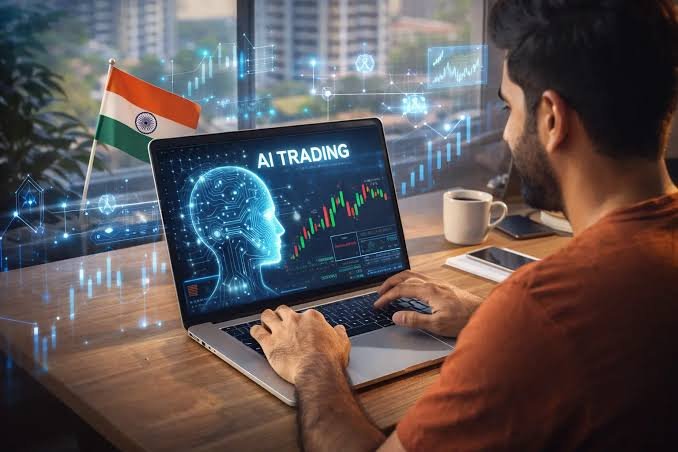
AI Trading Tools Are Not All the Same
The term AI trading tool covers several different technologies.
Some applications use machine learning models to examine historical prices. Others summarise financial news, identify chart patterns, or automate predefined calculations.
A few platforms combine artificial intelligence with algorithmic execution systems.
These technologies should not be treated as interchangeable.
For example, a chatbot explaining a company’s quarterly financial results performs a different task from a machine learning model estimating future price volatility.
Similarly, an automated trading programme may follow fixed instructions without using artificial intelligence at all.
Retail users should understand what a particular system actually does before accepting its AI-related claims.
Where AI Can Be Useful for Individual Market Participants
The most realistic applications involve organising information and reducing repetitive analytical work.
Financial Information Summarisation
AI tools can help explain lengthy financial reports, earnings announcements, and company disclosures.
For example, an Indian investor studying an NSE-listed company might use an AI assistant to understand accounting terminology appearing in its annual report.
However, generated summaries can contain errors or omit important qualifications.
Financial figures should always be checked against the original documents.
Historical Market Data Analysis
Machine learning systems can examine large datasets and identify statistical relationships.
They may help researchers study price volatility, trading volume, or correlations between securities.
These relationships describe patterns within available data.
They do not establish that similar patterns will continue in future markets.
Chart Interpretation
Some AI applications identify technical features such as moving averages, price trends, and historical support areas.
This can make chart analysis more accessible.
Nevertheless, recognising a chart pattern is not equivalent to accurately predicting future prices.
Educational Simulations
AI can also support learning through explanations, historical examples, and simulated market exercises.
Such applications allow users to examine financial concepts without exposing real money to market risk.
Why AI Market Predictions Are Often Unreliable
Financial markets are influenced by numerous changing factors.
Corporate earnings, interest rates, government policies, international developments, and investor expectations can affect securities prices.
An AI model trained on historical information may identify patterns that existed during particular market conditions.
However, those relationships can weaken or disappear.
This problem is especially important when models encounter circumstances that differ substantially from their training data.
For example, a system trained during a relatively stable market period may behave poorly during sudden volatility.
AI predictions should therefore be understood as uncertain estimates rather than reliable forecasts.
The Hidden Problem of Overfitting
One of the biggest challenges in AI-based trading research is overfitting.
Overfitting occurs when a model learns historical data too closely, including random fluctuations that do not represent durable relationships.
A model may appear extremely accurate when tested on information it has effectively already learned.
Its performance can deteriorate when exposed to genuinely new observations.
Researchers attempt to address this problem through careful data separation, out-of-sample evaluation, and other validation methods.
Even these techniques cannot guarantee future reliability.
For retail users, impressive historical performance charts should not be accepted as proof of a dependable trading system.
Can Retail Traders Compete With Institutional AI Systems?
Large financial institutions may employ specialised researchers, software engineers, quantitative analysts, and risk management teams.
They can also invest heavily in market data, computing infrastructure, and system monitoring.
Individual retail participants generally operate with fewer resources.
This creates practical differences in capabilities.
Institutional systems may have access to specialised datasets and sophisticated execution infrastructure that ordinary users cannot economically reproduce.
However, retail traders do not need institutional-level technology to benefit from basic financial data analysis.
AI-assisted research and educational tools can still be useful without attempting to compete in high-frequency trading.
What AI Trading Software May Cost
AI-related financial software is available through different pricing arrangements.
Some platforms offer limited free features, while others charge subscriptions or usage-based fees.
Costs may include:
- Software subscription charges.
- Historical or real-time market data access.
- Computing and cloud processing expenses.
- Additional analytical features.
- Platform integration charges.
- Technical maintenance and support.
A subscription fee is an expense, not evidence that the software can generate returns.
Users should also examine cancellation policies, data permissions, and the reliability of advertised features.
Regulatory Considerations for AI Trading in India
The Securities and Exchange Board of India regulates India’s securities markets and has established requirements affecting algorithmic trading and market intermediaries.
Retail access to automated order execution must comply with applicable exchange, broker, and regulatory arrangements.
Using AI for educational research or summarising publicly available financial information is different from connecting automated software to a live trading account.
The regulatory treatment depends on the actual service and activity involved.
Users should be cautious about third-party applications requesting trading credentials, account access, or permission to execute transactions.
AI-related branding does not establish regulatory approval or operational safety.
Warning Signs of Misleading AI Trading Platforms
Some providers market ordinary technical indicators as revolutionary artificial intelligence.
Others promote automated systems using unsupported profitability claims.
Important warning signs include:
- Promises of guaranteed daily returns.
- Claims of nearly perfect prediction accuracy.
- Unverified historical performance records.
- Pressure to deposit money immediately.
- Requests to share account passwords or OTPs.
- Lack of information about the software provider.
- No explanation of model limitations.
- Claims that financial losses are impossible.
A credible technology provider should clearly explain the software’s capabilities, limitations, and associated risks.
Frequently Asked Questions
Q1. Can beginners use AI tools to understand the Indian stock market?
A: Yes. AI tools can help explain financial terminology, summarise company information, and support educational analysis. Their outputs should be independently verified.
Q2. Can AI accurately predict Nifty 50 movements?
A: AI models can generate forecasts, but they cannot consistently guarantee accurate predictions. Market conditions change, and unexpected developments can invalidate historical patterns.
Q3. Are AI trading bots legal in India?
A: Automated trading arrangements must comply with applicable SEBI, exchange, and broker requirements. Whether a particular service is permitted depends on its functionality and regulatory compliance.
Q4. Is free AI software sufficient for learning market analysis?
A: Free tools may be adequate for studying basic financial concepts, historical data, and analytical methods. Paid subscriptions are not automatically more accurate.
Q5. Can AI replace human judgment in financial decisions?
A: AI can assist with information processing, but it cannot eliminate uncertainty, verify every assumption independently, or guarantee suitable financial decisions. Human oversight remains important.