No. Crop insurance is not compulsory for any farmer in India today. Under the Pradhan Mantri Fasal Bima Yojana (PMFBY), the main national scheme, enrolment has been voluntary for all farmers since the Kharif 2020 season. Before that, farmers who held crop loans from banks, such as Kisan Credit Card holders, were enrolled automatically. That compulsion was removed, and loanee farmers can now choose whether to take the cover or opt out. Scheme rules are revised from time to time, so check the latest guidelines with your bank or agriculture office before enrolling.
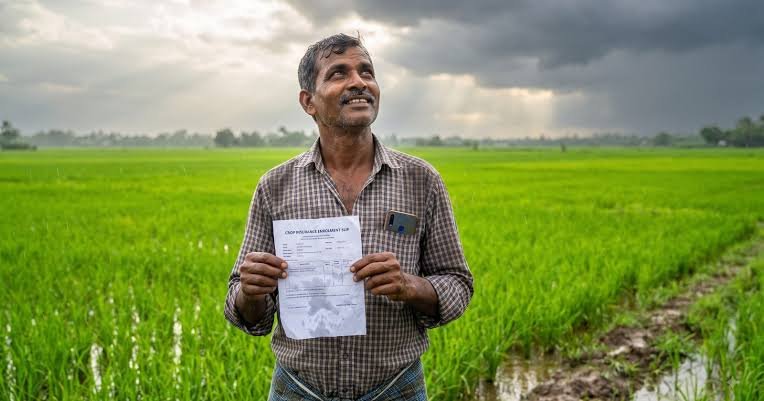
What Changed With the 2020 Reform
Earlier, banks deducted the premium directly when a farmer took a seasonal crop loan, and many farmers did not realise they had insurance until a loss occurred. The government changed the scheme so that participation depends on the farmer’s own choice.
- Non-loanee farmers: always voluntary.
- Loanee farmers: moved from compulsory to voluntary.
- Opting out: a loanee farmer who doesn’t want cover must submit a written declaration to the bank, usually at least a week before the cut-off date for that season.
If a loanee farmer does nothing, the bank may still enrol them, so those who don’t want the cover need to act in time. Check your bank’s current procedure.
Who Can Enrol
The scheme is open to all farmers growing notified crops in notified areas.
- Owner-cultivators.
- Sharecroppers and tenant farmers, with the required documentation.
- Small, marginal and large farmers alike.
Eligibility depends on the crop and area being notified by the state for that season, so a crop that isn’t notified in your district may not be insurable under the scheme.
What the Cover Protects Against
Crop insurance supports farmers when natural events hurt their harvest.
- Yield loss: from drought, dry spells, flood, pests and diseases, natural fire and lightning, storms, hailstorm and landslide.
- Prevented sowing: when conditions stop you from sowing in the insured area.
- Mid-season adversity: an advance payment in case of major mid-season loss.
- Post-harvest losses: damage to harvested crop during field drying, for a limited period.
- Localised calamities: hailstorm, landslide, inundation and cloudburst affecting individual fields.
What It Costs the Farmer
The government subsidises a large share of the premium, so the farmer pays a small percentage of the sum insured.
- Kharif food crops and oilseeds: commonly 2% of the sum insured.
- Rabi food crops and oilseeds: commonly 1.5%.
- Annual commercial and horticultural crops: commonly 5%.
The remaining premium is shared by the central and state governments. Check the current rates for your state, since they can be revised.
Why Many Farmers Choose to Enrol
Even though it isn’t compulsory, crop insurance has practical benefits.
- Protection against uncertainty: farming depends on weather, and one bad season can wipe out savings.
- Support for loan repayment: a payout helps farmers repay crop loans after a loss.
- Stable income for the next season: claim money can fund seeds and inputs for the next sowing.
- Low cost to the farmer: the subsidised premium is small compared to the sum insured.
- Credit confidence: insured farmers may find it easier to secure credit.
How to Enrol
Before the Cut-Off Date
Each season has a deadline, often around the end of July for kharif and the end of December for rabi, though dates vary by state and crop. Enrol before the cut-off.
Where to Enrol
- Your bank branch, including cooperative banks.
- Common service centres.
- The national crop insurance portal or mobile app.
- Authorised insurance company agents.
Documents Usually Needed
- Aadhaar or other identity proof.
- Land records or a tenancy or sharecropping agreement.
- Bank passbook with account details.
- Sowing certificate or self-declaration of sown crop, where required.
Accurate details prevent delays at claim time.
What About State Schemes?
Some states run their own crop insurance arrangements or variations alongside, or in place of, the national scheme, and a few have changed their participation over time. Rules about premium sharing and enrolment can differ, so ask your district agriculture office what applies in your area.
Weather-Based Crop Insurance
The Restructured Weather Based Crop Insurance Scheme pays out when weather indicators, such as rainfall or temperature, cross defined thresholds. It is also voluntary, and its claims depend on weather station data, not on field-level yield measurement.
Tips for Farmers Deciding Whether to Enrol
- Check which crops and areas are notified in your district.
- Compare the premium with the potential loss to your income.
- Keep your land and bank records up to date.
- Note the cut-off dates for each season.
- Save your receipt and policy number after enrolling.
- Report any localised loss within 72 hours through the app, helpline or your bank.
Frequently Asked Questions
Q1. Is crop insurance mandatory for farmers in India?
No. Enrolment under PMFBY is voluntary for all farmers, including those with crop loans.
Q2. Do loanee farmers have to take crop insurance?
Not anymore. Since the Kharif 2020 season, loanee farmers can choose whether to enrol or opt out.
Q3. How does a loanee farmer opt out?
By submitting a written declaration to the bank before the cut-off date, which is typically at least a week before the last enrolment date.
Q4. Can tenant farmers get crop insurance?
Yes, sharecroppers and tenant farmers are eligible with the required documents.
Q5. How much premium does a farmer pay?
Commonly 2% for kharif food crops, 1.5% for rabi crops and 5% for commercial and horticultural crops, with the government paying the rest.
Q6. Where can I enrol in crop insurance?
At your bank, a common service centre, the national crop insurance portal or app, or through an authorised insurer.