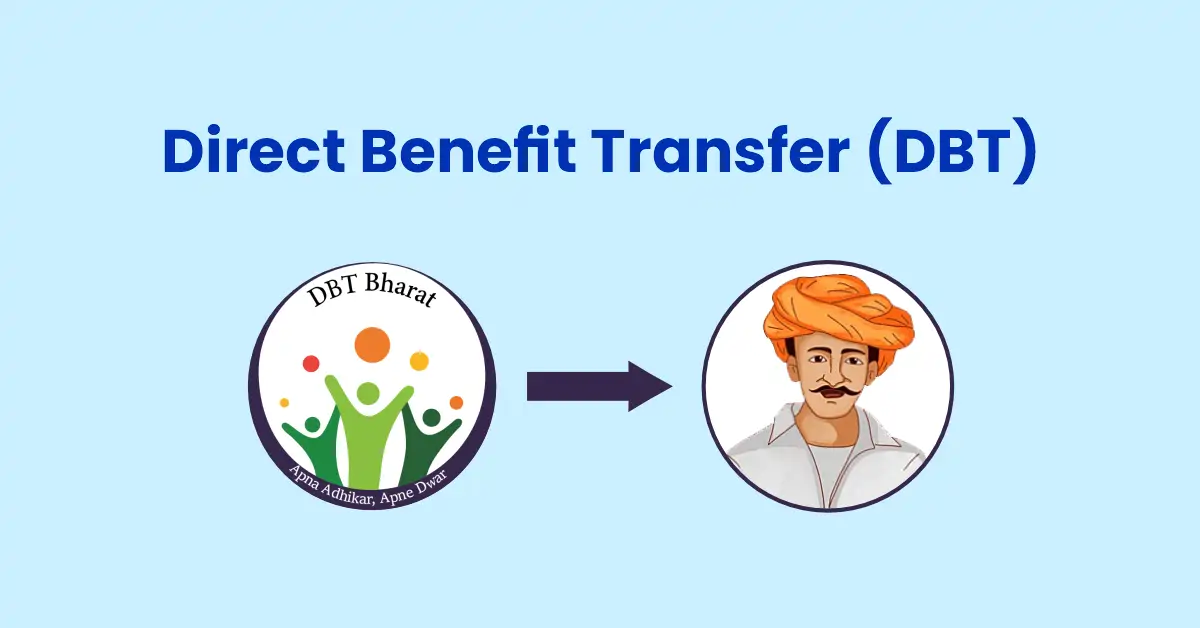
DBT stands for Direct Benefit Transfer. It is a Government of India initiative launched on January 1, 2013, to transfer subsidies and welfare benefits directly into the bank accounts of eligible beneficiaries — eliminating intermediaries, reducing leakages, and ensuring faster, more transparent delivery of government funds. Since inception, DBT has been implemented across 450+ central schemes, reaching over 900 million beneficiaries.
| Parameter | Details |
| Full Form | Direct Benefit Transfer |
| Launched | January 1, 2013 — Government of India |
| Nodal Body | DBT Mission, Cabinet Secretariat |
| Payment Platform | Public Financial Management System (PFMS) |
| Key Technology | Aadhaar Payment Bridge (APB) by NPCI |
| Schemes Covered | 450+ central government schemes |
| Beneficiaries Reached | Over 900 million people |
| Requirement | Bank account (Aadhaar-seeded preferred) |
| Key Examples | PM-KISAN, MGNREGS, LPG subsidy (PAHAL), scholarships, pensions |
DBT Meaning and Definition
DBT means a government payment mechanism that transfers cash subsidies, benefits, and entitlements directly from the government’s treasury into the bank accounts of eligible beneficiaries — bypassing all intermediaries and eliminating opportunities for pilferage or diversion.
Before DBT, subsidies passed through multiple administrative layers — ministry, state departments, district offices — before reaching beneficiaries. This multi-layer flow caused delays, corruption, and leakages. DBT re-engineered this system by using PFMS (Public Financial Management System) as the central payment platform and NPCI’s Aadhaar Payment Bridge (APB) as the routing mechanism — using the beneficiary’s Aadhaar number as the unique key to identify and credit the correct bank account.
NPCI’s Aadhaar Payment Bridge creates and maintains an Aadhaar mapper that links each Aadhaar number to the corresponding bank account. When a government ministry initiates a DBT payment through PFMS, NPCI routes the funds to the correct destination bank, which credits the beneficiary’s account. Aadhaar is not mandatory for all DBT schemes, though it is strongly encouraged as it enables precise targeting and eliminates duplicate beneficiaries.
How DBT Works — Step by Step
Step 1 — Beneficiary Identification: The government ministry identifies eligible beneficiaries for the scheme based on defined eligibility criteria (income, occupation, region, etc.).
Step 2 — Aadhaar and Bank Account Seeding: Beneficiaries link their bank account to their Aadhaar number, enabling the bank to register the account on NPCI’s Aadhaar Payment Bridge mapper.
Step 3 — Payment Initiation via PFMS: On the scheduled date, the ministry initiates the payment through PFMS. The payment file lists beneficiary Aadhaar numbers and the corresponding benefit amounts.
Step 4 — NPCI Routing via APB: NPCI uses the Aadhaar mapper to identify each beneficiary’s bank and routes the payment file to the respective destination banks.
Step 5 — Account Credit: Each destination bank processes the inward file and credits the individual beneficiary’s Aadhaar-linked account. The beneficiary receives an SMS alert confirming receipt.
Key Benefits of DBT
- Eliminates intermediaries — direct government-to-citizen fund transfer
- Reduces pilferage, corruption, and duplication of beneficiaries
- Faster disbursement — funds reach accounts electronically within the same day
- Promotes financial inclusion — encourages bank account opening in rural areas
- Real-time tracking and audit trail through PFMS and DBT Mission portal
- De-duplication using Aadhaar prevents multiple claims by the same person
Frequently Asked Questions
Q: What is the full form of DBT in banking?
DBT stands for Direct Benefit Transfer. It is a Government of India system that transfers subsidies and welfare benefits directly into beneficiaries’ bank accounts, eliminating intermediaries.
Q: Is Aadhaar mandatory for DBT?
Aadhaar is not mandatory for all DBT schemes, but it is strongly preferred. Seeding your bank account with Aadhaar enables NPCI’s Aadhaar Payment Bridge to route payments accurately and prevents duplication.
Q: How do I enable DBT in my bank account?
Visit your bank branch and request them to link your Aadhaar to your account by filling the bank’s consent form. The bank will seed your account to the NPCI Aadhaar mapper, enabling DBT-based credits.
Q: What are some major schemes under DBT?
Key DBT schemes include PM-KISAN (farmer income support), MGNREGS (wage payments), LPG subsidy under PAHAL, scholarship payments, pension distributions, and Janani Suraksha Yojana maternity benefits.