A 2% movement in a stock’s price does not always translate into a 2% change in the money someone has committed to a position. When borrowed funds or margin-based exposure are involved, the financial impact can be considerably larger.
This is the central principle behind leverage trading. It allows market participants to control an exposure greater than the capital they initially provide. The attraction is obvious: favourable price movements can produce proportionally larger returns on the trader’s own funds. The danger is equally significant because unfavourable movements are amplified.
In India’s financial markets, leverage appears in different forms, including margin trading facilities and derivatives.
Leverage does not improve the probability of a successful market prediction. It increases the financial consequences of the outcome, whether favourable or unfavourable.
The Mathematics Behind Leverage
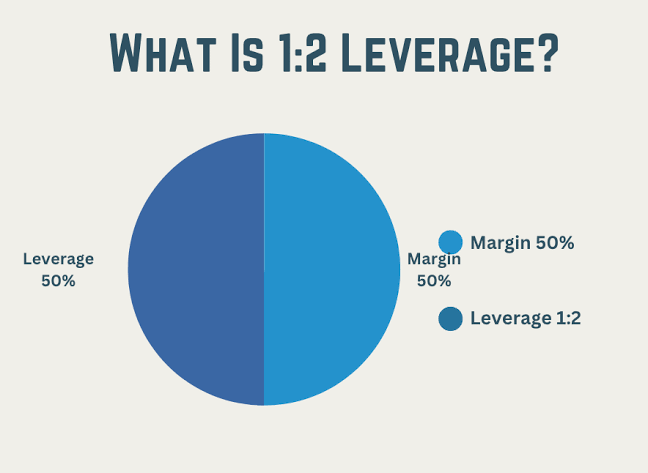
Leverage is commonly expressed as a ratio between total market exposure and the capital supporting that exposure.
For example, consider a hypothetical position worth ₹1,00,000 supported by ₹20,000 of personal capital.
The exposure is five times the initial capital.
If the position’s market value increases by 2%, the gross gain is ₹2,000.
That represents 10% of the original ₹20,000 capital.
However, if the market value decreases by 2%, the gross loss is also ₹2,000, equivalent to 10% of that capital.
The underlying asset moved only 2%, but the financial impact on the initial capital was five times larger.
This simplified illustration excludes borrowing costs, brokerage, taxes, and other expenses.
A Small Market Movement Can Produce a Large Financial Difference
The following example demonstrates the relationship between leverage and market movements.
Assume a hypothetical ₹1,00,000 market exposure supported by different amounts of initial capital.
| Leverage | Initial Capital | Impact of 2% Gain | Impact of 2% Loss |
| 1× | ₹1,00,000 | +2% | -2% |
| 2× | ₹50,000 | +4% | -4% |
| 5× | ₹20,000 | +10% | -10% |
| 10× | ₹10,000 | +20% | -20% |
These figures illustrate gross percentage changes relative to initial capital, not guaranteed returns or actual leverage offered by Indian brokers.
The table reveals an important relationship: greater leverage increases sensitivity to market movements.
It does not change the underlying asset’s price movement.
Why Losses Become Especially Difficult to Recover
Leverage introduces a mathematical problem that becomes more serious as losses accumulate.
Suppose an account loses 50% of its value.
A subsequent 50% gain would not restore the original amount. A 100% gain would be required to recover the loss.
This is because gains and losses are calculated on changing capital values.
Leverage can accelerate such declines by increasing the financial effect of adverse price movements.
Repeated losses may therefore reduce available capital much faster than someone expects from observing the underlying asset’s percentage changes.
How Leverage Appears in India’s Stock Market
Leverage is not a single financial product.
In India, different market arrangements create different forms of exposure.
Margin Trading Facility
A Margin Trading Facility (MTF) allows eligible securities to be purchased using a combination of customer funds and financing provided by an authorised broker, subject to applicable regulations.
The financing generally involves interest and margin requirements.
If the value of the financed securities declines, additional collateral requirements or other contractual consequences may arise.
Futures Contracts
Futures provide exposure to an underlying asset or index through standardised exchange-traded contracts.
Participants provide prescribed margins rather than paying the full notional contract value upfront.
However, gains and losses reflect changes in the contract’s value.
Options Contracts
Options require a more careful distinction.
An option buyer pays a premium, and the option’s price may change substantially relative to that premium.
For a straightforward purchased option, the maximum loss is generally limited to the premium paid and associated costs.
Option sellers face different obligations and potentially substantial losses, depending on the position.
Therefore, options should not be described as though every participant has identical leverage or risk.
Margin Calls and Forced Position Closures
One of the least understood aspects of leveraged exposure is that financial consequences may arise before someone voluntarily closes a position.
Margin requirements exist to protect the financial system against settlement and counterparty risks.
When available collateral becomes insufficient, a broker may require additional funds or securities.
Depending on the applicable rules and contractual arrangements, positions may be reduced or closed.
Important implications include:
- Market declines can reduce available margin.
- Additional collateral requirements may arise.
- Financing costs can continue while borrowing remains outstanding.
- Forced closures may occur during unfavourable market conditions.
- Rapid price movements can produce losses beyond initial expectations.
These risks are particularly relevant when markets become volatile or liquidity deteriorates.
Leverage Also Changes the Importance of Trading Costs
A leveraged position may involve expenses that are less prominent in an unleveraged investment.
Margin financing can attract interest.
Derivatives transactions involve applicable brokerage, exchange charges, statutory taxes, and other costs.
Such expenses reduce net financial results.
Even when the market price moves favourably, the actual outcome depends on the total costs associated with the position.
Why SEBI Places Restrictions on Leverage
India’s securities market operates under margin and risk-management frameworks established through SEBI, recognised exchanges, and clearing corporations.
These frameworks address collateral, exposure limits, margin collection, and other safeguards.
Requirements vary by product and market segment.
The purpose is not to guarantee profits or prevent every loss. Rather, these measures seek to reduce excessive exposures and strengthen market stability.
Regulatory restrictions also mean that leverage advertised by an overseas platform may not be available or permissible through an Indian securities intermediary.
Frequently Asked Questions
Q1. What does 5× leverage mean in trading?
A: It means total market exposure is five times the capital supporting the position. A given percentage movement in the underlying exposure can therefore produce a much larger percentage change relative to that capital, before expenses.
Q2. Can leverage trading cause losses greater than the initial investment?
A: Yes, certain leveraged positions can produce losses exceeding the initial margin or capital committed. The outcome depends on the financial instrument, position structure, and applicable protections.
Q3. Is leverage trading legal in India?
A: Permitted leverage arrangements are available through authorised intermediaries under applicable SEBI, exchange, and regulatory requirements. Not every advertised leverage product is authorised.
Q4. Does leverage increase the chances of making a profit?
A: No. Leverage increases exposure to market movements but does not improve forecasting accuracy or the probability of a favourable outcome.
Q5. Is leverage the same as borrowing money?
A: Not always. Margin financing involves borrowing, while derivatives can create leveraged exposure through contractual obligations without functioning as an ordinary cash loan.