Two people can study the same trading strategy, examine identical stock charts, and understand the same technical indicators, yet make completely different decisions when market prices begin changing rapidly. The difference often lies not in their knowledge of the strategy but in how they respond to uncertainty.
Trading psychology examines the emotions, expectations, cognitive biases, and behavioural patterns that influence financial decisions. It explains why someone may abandon a carefully researched plan, become overconfident after favourable outcomes, or interpret market information selectively.
In India’s increasingly accessible securities markets, understanding these psychological influences is particularly relevant. Digital trading platforms make financial information readily available, but convenient access does not eliminate emotional decision-making.
A trading strategy describes an analytical method, while trading psychology influences whether that method is interpreted and applied consistently. Both matter, and neither can guarantee favourable financial results.
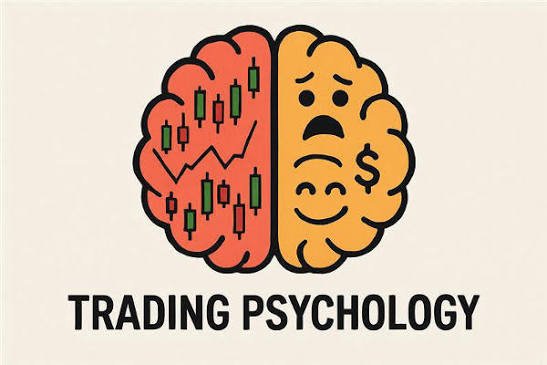
A Good Strategy Cannot Correct Every Human Decision
A strategy may contain clearly defined assumptions about market direction, volatility, and historical price behaviour.
However, the person interpreting those assumptions still makes judgments.
Consider an analyst reviewing a hypothetical stock that has experienced several consecutive price increases.
The analytical framework may suggest that the movement is unusually extended.
Nevertheless, excitement surrounding the rising price may cause the individual to overlook contradictory information.
The problem is not necessarily a failure of technical analysis. It may be a failure to evaluate evidence objectively.
This distinction explains why financial education increasingly includes behavioural finance alongside traditional market analysis.
The Psychological Traps That Influence Market Behaviour
Human decision-making is affected by several well-documented cognitive tendencies.
Some are particularly relevant when evaluating uncertain financial outcomes.
Loss Aversion
Loss aversion describes the tendency for losses to feel more significant than equivalent gains.
This can influence how people evaluate financial decisions.
Someone may become excessively focused on avoiding the emotional discomfort associated with an unfavourable outcome.
As a result, their judgment may become inconsistent with their original analysis.
Overconfidence
Overconfidence occurs when individuals overestimate their knowledge, predictive ability, or control over outcomes.
A sequence of favourable market observations may encourage someone to believe their analytical method is more reliable than the evidence supports.
However, short-term results can be influenced by chance and prevailing market conditions.
Confirmation Bias
Confirmation bias involves favouring information that supports an existing belief.
For example, someone expecting a particular NSE-listed company to perform well may concentrate on positive announcements while overlooking declining profitability or other unfavourable developments.
This can create an incomplete understanding of the available evidence.
Recency Bias
Recency bias occurs when recent experiences receive disproportionate importance.
After a prolonged market rally, investors may begin assuming that prices will continue rising.
Following a sharp decline, they may become excessively pessimistic.
Neither expectation necessarily reflects the full range of possible outcomes.
Why Market Volatility Intensifies Emotional Reactions
Financial uncertainty becomes more noticeable when prices fluctuate sharply.
During relatively stable periods, individuals may feel confident about their understanding of market behaviour.
Sudden volatility can challenge that confidence.
Indian securities markets respond to domestic developments, international economic conditions, corporate announcements, and changes in investor expectations.
These influences can produce movements that differ substantially from historical patterns.
Psychological reactions during such periods may include:
- Anxiety about unexpected financial losses.
- Excessive confidence after favourable outcomes.
- Pressure to follow popular market opinions.
- Difficulty accepting uncertainty.
- Selective attention to reassuring information.
- Impulsive decisions following dramatic headlines.
Recognising these reactions is an important part of financial literacy.
Social Media Can Reinforce Poor Financial Judgment
Online discussions have become a significant source of market commentary.
Financial influencers, discussion groups, and short-form videos frequently present opinions about individual stocks and market indices.
Some provide useful educational explanations.
Others emphasise dramatic predictions or display selected examples of profitable transactions.
This environment can encourage herd behaviour, where individuals adopt opinions primarily because many others appear to share them.
It can also create fear of missing out, commonly called FOMO.
A popular market narrative is not automatically supported by reliable financial evidence.
For Indian investors, checking claims against company disclosures and credible market information is more valuable than relying on popularity alone.
Strategy Discipline Is Really a Decision-Making Process
Discipline is sometimes presented as the ability to suppress emotions completely.
That interpretation is unrealistic.
Emotions are normal responses to uncertainty.
A more useful understanding of discipline involves recognising emotional influences and maintaining a consistent analytical process.
Important habits include:
- Recording the reasoning behind financial observations.
- Identifying assumptions before examining outcomes.
- Considering evidence that challenges an existing opinion.
- Distinguishing probability from certainty.
- Reviewing mistakes without relying on hindsight.
- Avoiding decisions driven solely by excitement or fear.
These practices can improve the quality of financial reasoning without promising particular market results.
Why Trading Journals Help Reveal Behavioural Patterns
A trading journal is not merely a record of prices and transactions.
It can also document the thinking behind market observations.
For example, a historical chart study might record the original interpretation, supporting evidence, conflicting information, and subsequent developments.
Reviewing these records can reveal whether certain biases appear repeatedly.
An analyst may discover that optimistic interpretations become more common after favourable market periods.
Another may notice a tendency to disregard contradictory information.
Such observations are difficult to identify through technical indicators alone.
A journal therefore provides a way to examine the decision-making process separately from financial outcomes.
Psychology Cannot Rescue a Fundamentally Weak Strategy
Although trading psychology matters, it should not be treated as a substitute for sound financial analysis.
A strategy based on incorrect assumptions will not become reliable simply because someone follows it consistently.
Similarly, confidence and emotional control cannot eliminate market volatility, transaction costs, or unexpected economic developments.
Effective financial reasoning requires several elements working together:
- Accurate information.
- Clearly defined analytical assumptions.
- Awareness of financial risk.
- Recognition of behavioural biases.
- Willingness to revise unsupported conclusions.
Psychological discipline helps people evaluate their methods more consistently, but the underlying methods must still withstand critical examination.
Frequently Asked Questions
Q1. What is trading psychology?
A: Trading psychology refers to the emotions, cognitive biases, expectations, and behavioural tendencies that influence how individuals interpret financial information and make market-related decisions.
Q2. Why do people ignore their trading strategies?
A: Fear, overconfidence, uncertainty, confirmation bias, and pressure from recent market movements can influence judgment, sometimes causing individuals to depart from their original analytical methods.
Q3. Is trading psychology more important than technical analysis?
A: Both serve different purposes. Technical analysis examines historical market behaviour, while trading psychology addresses human decision-making. Neither independently guarantees successful financial outcomes.
Q4. Can beginners improve trading psychology without using real money?
A: Yes. Historical chart studies, simulated market exercises, and reflective journals can help beginners identify cognitive biases and practise evaluating financial information consistently.
Q5. Does emotional discipline guarantee profitable trading?
A: No. Emotional discipline may support more consistent decision-making, but market uncertainty, analytical errors, and changing economic conditions can still produce unfavourable results.