Walk into a mall in any major Indian city and you’ll likely pass at least three different furniture retail formats within a hundred metres — a Home Centre showroom stacked with ready-made pieces, an @home outlet chasing a slightly more upscale crowd, and somewhere nearby a QR code pointing you toward Pepperfry’s app for the same category at a different price point. Top 10 Furniture Store Chains in India 2026 reflect this genuine three-way split the industry has settled into: pure e-commerce marketplaces, hybrid online-offline retailers, and traditional showroom-first chains, each carved out for a distinctly different kind of shopper. Here’s where India’s furniture retail landscape actually stands.
| Rank | Chain | Format | Positioning |
| 1 | Pepperfry | Online + physical studios | Wide variety, affordable to premium |
| 2 | IKEA India | Large-format showrooms | Scandinavian minimalist, DIY |
| 3 | Home Centre | Showroom chain (Landmark Group) | Ready-made, vast inventory |
| 4 | Nilkamal | Mass-market retail | Affordability, plastic & mass furniture |
| 5 | @home | Premium retail (Nilkamal brand) | Contemporary lifestyle furniture |
| 6 | Urban Ladder | Online + experience stores | Modern, urban small-home design |
| 7 | Wakefit | Online direct-to-consumer | Beds, mattresses, ergonomic |
| 8 | Evok | Showroom + franchise | Contemporary home furnishing |
| 9 | Durian | Premium showroom chain | Sofas, premium seating |
| 10 | Royaloak | Offline + online retail | Modern imported-style furniture |
1. Pepperfry
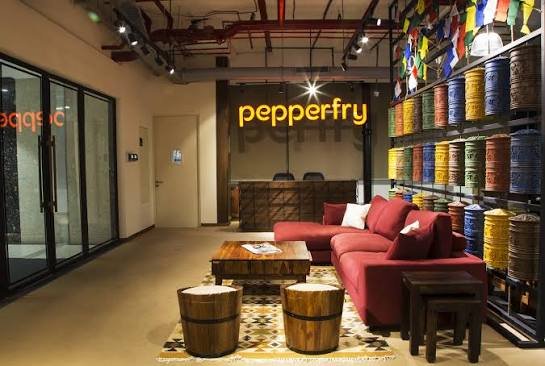
Pepperfry has grown into India’s most complete furniture retail destination, running an extensive online catalogue alongside physical “Studio” locations that let customers actually sit on the sofa before buying it.
- Aggregates thousands of products sourced from multiple manufacturers, spanning nearly every budget tier
- Bridges the trust gap in furniture e-commerce through its network of Studio stores across major cities
- Regularly stocked alongside global names at large furniture retail destinations, reflecting its distribution strength
- Serves as the default comparison point whenever India’s furniture retail market gets discussed
2. IKEA India
IKEA has brought its instantly recognisable flat-pack, Scandinavian aesthetic to India, though its physical footprint remains genuinely small relative to its brand recognition.
- Delivers globally consistent design and quality, backed by IKEA’s international supply chain
- Currently confined to large-format stores in only a handful of Indian metros
- Self-assembly requirements remain a genuine friction point for a meaningful share of Indian buyers
- Best suited to smaller, space-conscious urban homes seeking minimalist design solutions
3. Home Centre
Home Centre, part of the Dubai-based Landmark Group, has built one of the country’s most extensive ready-made furniture showroom networks.
- Prioritises walk-in browsing and immediate purchase over made-to-order customisation
- Carries vast inventory spanning bedroom, living room, and dining furniture categories
- Positioned squarely for India’s broad middle-class buyer across mall and standalone locations
- Represents the traditional showroom-first retail experience many Indian buyers still prefer
4. Nilkamal
Nilkamal, operating since 1981, remains the single most geographically accessible furniture brand in the country, built almost entirely on unbeatable affordability.
- Offers basic plastic furniture starting around ₹800, a price point no organised competitor can genuinely match
- Distribution reaches virtually every Indian town through retail stores, distributors, and e-commerce combined
- Product range spans chairs, tables, wardrobes, and storage units for both home and office use
- Functions as the default budget option across urban and rural India alike
5. @home
@home operates as Nilkamal’s more stylish sibling brand, deliberately built to capture buyers who’ve outgrown the parent brand’s purely budget positioning.
- Targets a meaningfully more design-conscious, upscale customer than core Nilkamal
- Found in malls and dedicated home stores across India’s larger cities
- Bridges Nilkamal’s mass-market base with the country’s expanding premium furniture segment
- Demonstrates how a single furniture group can successfully run two distinctly positioned retail brands
6. Urban Ladder
Urban Ladder built its identity around furniture genuinely designed for how modern, space-constrained Indian homes actually function.
- Sells primarily online, supported by experience stores where shoppers can view pieces in person
- Known for compact, design-led furniture aimed at younger, urban buyers
- Competes directly with Pepperfry for India’s digitally native furniture-shopping demographic
- Remains one of the most recognisable names specifically associated with small-home furniture solutions
7. Wakefit
Wakefit took a narrower approach than most competitors, building its entire retail model around beds and mattresses before expanding into broader bedroom furniture.
- Operates a direct-to-consumer online model, cutting out traditional retail markups
- Positioned as affordable-to-mid-range, appealing strongly to first-time home furnishers
- Backed by genuine in-house manufacturing rather than pure third-party aggregation
- Built its reputation through product-led digital marketing rather than showroom presence
8. Evok
Evok runs a genuinely hybrid retail model, combining company-owned stores with an active franchise network across the country.
- Operates 13 owned stores alongside 15 franchise outlets nationally
- Product range extends into work-from-home and outdoor furniture, beyond standard living room pieces
- Positioned with a more contemporary aesthetic than several older, more traditional chains
- Continues to grow primarily through its franchise expansion strategy
9. Durian
Durian has carved out a premium niche, particularly recognised for sofas and seating that prioritise comfort over budget positioning.
- Operates more than 33 outlets nationally, each carrying a genuinely premium product range
- Best known specifically for high-comfort living room seating and sofa collections
- Also maintains a meaningful presence in premium office furniture
- Occupies the higher-end, experience-driven segment of India’s organised furniture retail
10. Royaloak
Royaloak runs a genuinely blended retail strategy, using both physical showrooms and online sales to reach customers furnishing entire homes at once.
- Combines offline and online channels under one consistent brand experience
- Offers modern, internationally-styled furniture positioned at mid-range pricing
- Competes directly with Urban Ladder and Pepperfry for design-conscious, budget-aware shoppers
- Represents the increasingly common hybrid retail model among India’s mid-tier furniture brands
Frequently Asked Questions
Q1. Which furniture retailer is best if I want to see and touch pieces before buying?
Home Centre, Durian, and Pepperfry’s Studio locations all offer strong in-person browsing experiences, letting you evaluate build quality and comfort before committing to a purchase.
Q2. Is IKEA worth the trip if I don’t live near one of its stores?
It depends on what you’re after — IKEA’s minimalist design and pricing are genuinely distinctive, but self-assembly and limited locations mean many buyers find comparable value closer to home through Urban Ladder or Pepperfry.
Q3. What’s the real difference between Nilkamal and @home if they’re the same parent company?
Nilkamal focuses on budget, high-durability basics available almost everywhere, while @home targets a more design-conscious buyer willing to pay more for contemporary styling.
Q4. Which chain is best specifically for furnishing a small city apartment?
Urban Ladder and IKEA both design specifically with compact urban living in mind, offering space-efficient pieces that traditional showroom chains like Home Centre don’t always prioritise.