Ask a shopkeeper in Ludhiana or a small online seller in Jalandhar what they look at when picking a payment gateway, and the answer is nearly always the transaction fee. Which is reasonable, except that most of the major Indian gateways charge roughly the same around 2% on standard payment methods.
The number that varies far more, and that almost nobody compares, is how long the gateway holds your money before putting it in your bank account.
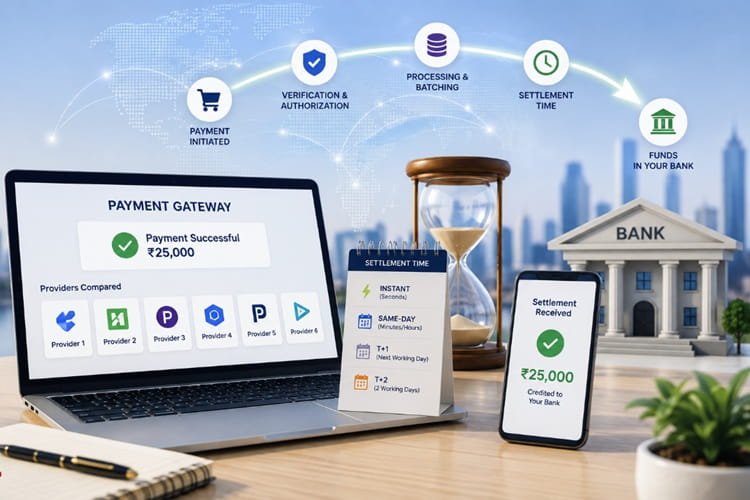
A customer pays you today. Depending on your provider and your plan, that money reaches you tomorrow, the day after, or in seconds. For a business buying stock weekly or paying suppliers on tight terms, that gap matters more than a fraction of a percent of the fee.
Why Payment Gateway Settlement Takes Time
When a customer pays, the money does not travel straight from their bank to yours. It moves through card networks or UPI rails to the gateway’s acquiring bank, gets checked and batched, and only then gets released to you.
That process needs some time. But how much time is a business decision the gateway makes, not a law of nature which is why the same transaction can take two days at one provider and seconds at another.
The standard across the Indian market is what the industry calls T+1 or T+2: your money arrives one or two working days after the transaction. The catch is in the phrase “working days”. A payment taken on Friday evening before a long weekend can easily sit until Tuesday or Wednesday.
Payment Gateway Settlement Times Compared
| Provider | Standard settlement | Faster option available? |
| Cashfree Payments | T+1 | Yes, within seconds; also same-day and scheduled cycles from 15 minutes, including bank holidays |
| Easebuzz | T+1 | Available |
| Razorpay | T+2 | Yes, instant and on-demand settlement |
| PayU | T+2 | Yes, Priority Settlements, aimed at larger merchants |
| Paytm | T+2 | T+1 and same-day available at extra cost |
| CCAvenue | T+2 to T+3, per its published material | Limited |
Settlement terms depend on your business category, plan and the provider’s risk assessment, and change over time. Treat this as a starting point and confirm your own terms in writing.
What Does “Instant Settlement” Actually Mean?
Not all fast settlement is the same, and the differences are worth understanding before you pay for it.
On-demand means you press a button when you need the money and it moves. Good if your cash needs are irregular. Razorpay and Cashfree both offer a version of this.
Scheduled means the gateway settles automatically at set intervals through the day rather than once at the end of a cycle. Cashfree, for instance, offers scheduled cycles from fifteen minutes and runs them on bank holidays, useful if you sell steadily through the day and want a continuous inflow rather than one lump.
Same-day means a fixed release at set times, typically morning and evening. Less flexible but predictable, which suits businesses that plan payments around a daily routine.
All the major providers charge separately for these. The fee is usually a percentage of the amount settled early, and it varies by provider, plan and business category so the only number that matters is the one quoted to you.
Is Faster Payment Gateway Settlement Worth the Cost?
This is the part most articles skip, so here is the arithmetic.
Suppose you process ₹10 lakh a month and your provider quotes 0.30% for instant settlement. That is ₹3,000 a month, or ₹36,000 a year and about ₹42,500 once you add GST at 18%.
Whether that is money well spent depends on one question: what do you do with the cash you get a day or two earlier?
If you are a trader who reinvests immediately by buying stock that sells within a week, or funding advertising that brings orders the same day then getting your money sooner means you turn your capital more times a year. On thin retail margins, a few extra turns can clear that cost.
If you are currently borrowing to bridge the gap, compare the fee against what your working capital loan or overdraft actually costs. Faster settlement is often cheaper than the credit it replaces.
But if the money simply sits in your current account after it arrives, you are paying for speed you do not use. Plenty of businesses buy instant settlement because it sounds better, and it is a straight cost to them.
Run your own numbers before opting in. Take last month’s turnover, apply the rate you have been quoted, add GST, and ask honestly what you would have done with the money two days sooner.
3 Things to Check Before Choosing a Settlement Cycle
1. Ask what your settlement cycle actually is, in writing: Advertised terms are for standard plans. Newer businesses and certain categories like travel, education, anything with high refund rates are frequently placed on longer cycles, or with a rolling reserve: a portion of your takings held back by the gateway for a set period to cover possible refunds. Better to know at the start.
2. Check holiday behaviour: For a business selling through festival periods, when banks close and sales peak at the same time, whether your gateway settles on holidays can matter more than its everyday speed.
3. Check that the settlement report is usable: Fast money you cannot match against orders creates a different problem. Make sure the report identifies which transactions make up each payout, so your accountant is not reconstructing it by hand.
Which Payment Gateway Settlement Speed Is Right for Your Business?
Settlement speed is the difference between gateways that most merchants never compare and often should. The fees are broadly similar; the cash-flow terms are not.
For most small businesses the standard cycle is perfectly adequate. For anyone who reinvests revenue quickly, or who is currently paying interest to bridge a two-day gap, the faster options are worth pricing out properly rather than dismissing as an upsell.
Frequently asked questions
What Do T+1 and T+2 Mean in Payment Settlement?
The number of working days after a transaction before the money reaches your bank. T+1 is the next working day; T+2 is the day after that. Weekends and bank holidays do not count.
Can I Negotiate My Payment Gateway Settlement Cycle?
Often yes, particularly as your volume grows. Worth asking at renewal providers will sometimes improve the cycle rather than reduce the rate.
Does Faster Settlement Cost More?
Usually the transaction fee stays the same and the faster settlement is charged separately, as a percentage of the amount settled early, plus GST.
How Do Refunds Work With Faster Settlement?
Refunds are handled separately from settlement and typically take a few working days to reach the customer’s account, regardless of how fast your own settlement is.