However, registering a company in India until now meant only one thing – the incorporation of a Private Limited Company with a minimum of two directors and two shareholders according to the Companies Act. This was reasonable in regard to companies owned by a team of people, yet this created problems for those entrepreneurs who needed the protection provided by a company but could not find a partner. Quite often individuals were left with no choice but to be unregistered sole proprietors, bearing all the risks themselves, or get some person they knew to register as an additional director.
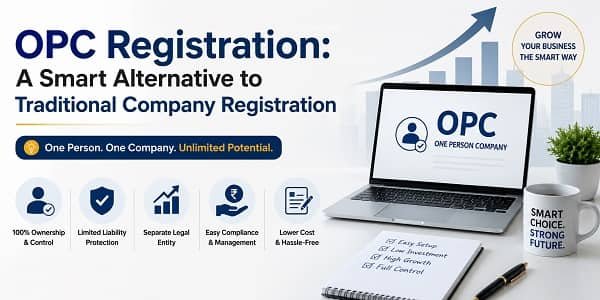
An OPC, established according to Section 2(62) and Section 3(1)(c) of the Companies Act, 2013, was created specifically to address the above mentioned problem. The one is not an alternative but the corporate form itself, suitable only for a certain type of business owners. For a certain type of founder, it turned out to be much more effective than a regular way of registration.
What Counts as “Traditional” Company Registration?
Conventionally speaking, company registration involves the registration of a Private Limited Company under the Companies Act, 2013, and involves a minimum number of 2 directors and 2 shareholders, along with greater governance requirements and the Annual General Meeting requirement.
However, such a method is ideal only in the case of a business that has been started by more than one individual. However, in the case of companies that do not have a second stakeholder, such a practice becomes redundant, and hence, the OPC method has been devised to bridge this gap.
Did You Know? The idea of a single-member company is not exclusive to India as other countries such as the UK, Singapore, among several EU countries allow single-member companies. The Indian OPC system, which was brought into existence via the Companies Act, 2013, owes its origins to such an international precedent.
Why OPC Is a Genuine Alternative, Not a Compromise
1. No Need to Get Another Co-owner
Largest structural difference is that an OPC requires just one member who can serve as the only director in the OPC, whereas traditional Private Limited Company registration requires at least two members and two directors. This means that there is no need to get another co-owner and take all procedures that are required just to satisfy some legal formality.
2. Equally Strong Legal Protection
An OPC is considered to be a private company and enjoys the same legal protection as any other private company, including limited liability and legal personality. So, opting for an OPC doesn’t mean that one has decided to trade off legal protection.
3. Reduced Corporate Governance Procedures
Traditional Private Limited Companies are required to conduct Annual General Meetings and observe more elaborate rules when holding meetings of the Board of Directors. OPCs don’t have to have their AGM, while Single Director OPC is exempted from conducting more than one board meeting per each six months period, which is significantly easier for a business operated by one person.
4. Quick & Easy Filing
Since there will be no documents of the second director, DSC, or the agreement for coordination, the incorporation of OPC via the SPICe+ form on the MCA V3 Portal would generally be easier and take less time to get completed, usually taking around 7 to 10 working days.
5. Unlimited Scalability without Consequences
Traditionally, if an OPC reached ₹50 lakh paid up capital or ₹2 crore turnover, then it was mandated that the OPC be compulsorily converted into Private Limited Company; thereby, it was seen as a transitional entity, rather than a permanent one. However, this is no longer the case now after the Companies (Incorporation) Second Amendment Rules, 2021.
OPC vs Traditional Private Limited Company Registration
| Feature | Traditional Private Limited Company | OPC (Alternative) |
| Minimum Members | 2 shareholders, 2 directors | 1 member, who can also be sole director |
| Legal Identity | Separate legal entity | Separate legal entity |
| Liability Protection | Limited | Limited |
| AGM Requirement | Mandatory | Not required |
| Board Meeting Norms | More frequent, structured | Relaxed (1 per half-year for single-director OPC) |
| Equity Fundraising | Straightforward, can issue shares to investors | Restricted, single shareholder by definition |
| Growth Restrictions | None | None (removed by 2021 amendment) |
| Filing Complexity | Higher, multiple directors’ documents & consents | Lower, single member/director filing |
| Conversion Flexibility | N/A | Can convert to Pvt Ltd anytime, no lock-in |
| Best Suited For | Teams, businesses planning to raise equity funding | Solo founders wanting credibility without a co-founder |
Where Traditional Private Limited Registration Still Wins
A true comparison involves admitting when the conventional route is the one to take:
- Equity raising is simple. An unlimited number of shares can be issued by a Private Limited Company; an OPC does not allow for equity investments from any other entity, being a single-shareholder company by definition.
- The ESOPs can be done. Founders who wish to recruit high-caliber people with the help of equity will require a Private Limited Company.
- Founders who are two or more. If a company actually has two or more founders right from the start, then OPC cannot work for it at all.
- Image issues in certain industries. In some industries where there is more understanding of the Private Limited Companies’ model, such as fintech and deep tech, some founders prefer this route from the very beginning.
How to Register an OPC (The Alternative Route)
| Step | What Happens |
| 1. Digital Signature Certificate (DSC) | Obtain a Class 3 DSC for the sole director |
| 2. Name Reservation | File SPICe+ Part A on the MCA V3 portal |
| 3. Nominee Appointment | File Form INC-3; nominee’s name must appear in the MOA, per the Companies (Incorporation) Amendment Rules, 2023 |
| 4. SPICe+ Part B Filing | Submit MOA (INC-33), AOA (INC-34), registered office proof, and identity documents |
| 5. Certificate of Incorporation | RoC issues the COI along with company PAN and TAN |
| 6. Post-Incorporation Compliance | File INC-20A within 180 days; appoint a statutory auditor within 30 days |
Eligibility checklist:
- Must be a natural person who is an Indian citizen (residents and NRIs eligible since the 2021 amendment)
- Residency threshold: 120 days in the preceding financial year
- One OPC per individual at a time
- Cannot be incorporated as, or converted into, a Section 8 (non-profit) company
Typical cost: ₹8,000 – ₹18,000+, depending on authorised capital, state, and professional assistance. Typical timeline: 7 to 10 working days with complete, correct documentation.
Post-Incorporation Compliance Checklist for OPCs
- Statutory Auditor must be appointed within 30 days from the date of incorporation
- INC-20A (commencement of business) must be filed within 180 days
- One board meeting must be held in each half of the year, separated by 90 days gap
- Annual filing of AOC-4 (financial statements)
- Annual filing of MGT-7A (abridged annual return)
- Annual Statutory Audit filing regardless of the volume of business.
Penalty for non-compliance – Filing of ROC documents like AOC-4/MGT-7A after the deadline is liable to fine of ₹100 per day with no upper limit.
Latest Legal Developments Making OPC a Stronger Alternative
Latest News: The Companies (Incorporation) Second Amendment Rules, 2021 remain in force in 2026, meaning the mandatory conversion trigger based on turnover or paid-up capital continues to be absent, and NRIs remain eligible to register OPCs. The Companies (Incorporation) Amendment Rules, 2023, requiring nominee details to be stated in the MOA, also continues to apply, tightening succession clarity for OPCs registered today.
Case Study: A solo SaaS founder initially registered a Private Limited Company with a friend listed as a nominal second director, purely to meet the incorporation minimum, with no real involvement in the business. Years later, converting the company to reflect true single ownership involved a formal share transfer and board resolution, friction that could have been avoided entirely by choosing OPC as the alternative from the start.
Common Mistakes When Choosing Between OPC and Traditional Registration
- Registering a Private Limited Company with a placeholder second director instead of using OPC
- Assuming OPC is a “temporary” or lesser structure that must eventually convert
- Overlooking OPC’s restriction on equity fundraising when investor interest is already likely
- Not appointing a nominee before filing SPICe+, which delays incorporation
- Ignoring the mandatory statutory audit requirement that applies to OPCs regardless of turnover
Conclusion
The traditional two-director, two-shareholder company registration route was never designed with solo founders in mind, it simply became the default because, for a long time, it was the only real option for incorporating a company in India. The OPC framework changes that. It offers the same limited liability and separate legal identity as a traditionally registered Private Limited Company, with lighter governance and faster filing, and, since the 2021 amendment, no forced return to the traditional structure as the business grows. For a solo founder, that makes OPC not a compromise, but a legitimately smarter alternative, provided fundraising and ESOPs aren’t imminent.
Choosing between the two structures still comes down to specifics, your growth plans, funding timeline, and how the business is actually owned. Getting that decision, and the filing itself, right is where professional guidance genuinely helps.
Why Choose Zolvit
- Expert lawyers and CAs who help you decide between OPC and Private Limited Company registration
- Company Secretary support for MOA, AOA, and nominee documentation
- Fast processing, incorporation in as little as 7 days
- Affordable, transparent pricing with no hidden costs
- End-to-end compliance, audits, ROC filings, and annual returns managed for you
- Dedicated support, including OPC-to-Private-Limited conversion whenever you’re ready to scale
Frequently Asked Questions
Q: Is OPC a legally weaker alternative to a Private Limited Company?
A: An OPC carries the same limited liability protection and separate legal identity as a Private Limited Company. It differs in ownership structure and governance requirements, not in the strength of its legal protections.
Q: Can an OPC later be converted into a traditional Private Limited Company?
A: YES. Since the Companies (Incorporation) Second Amendment Rules, 2021 removed the earlier two-year lock-in, an OPC can be converted into a Private Limited Company at any time, based on the founder’s needs.
Q: Should a founder expecting VC funding register an OPC instead of a Private Limited Company?
A: Because an OPC can have only one shareholder, it cannot issue shares to investors. Founders expecting to raise equity funding soon are better off registering directly as a Private Limited Company.
Q: Is OPC registration faster than traditional Private Limited registration?
A: YES. Because OPC filing involves only one member’s documentation instead of two directors’ and shareholders’ paperwork, it is generally quicker to file and process, typically completing in 7–10 working days.
Q: Does an OPC require the same annual compliance as a traditional company?
A: Largely similar, but lighter. OPCs still require a mandatory statutory audit and annual ROC filings (AOC-4, MGT-7A), but are exempt from holding Annual General Meetings, unlike a traditional Private Limited Company.